
Throughout the past few years many aspects of Boston have been depicted in books (George V. Higgins, Dennis Lehane, Robert Parker novels and more) as well as in the cinema. Most recently, Mystic River, Gone Baby Gone, The Departed to name only a few. Not surprisingly the reader or viewer is mostly treated to the underbelly of the underworld–though there have been some exceptions—Good Will Hunting, for example.
As a detective fiction writer, I too use Boston as a background for my mysteries. But the alpha and omega of my town is neither the crime world or its historical significance and the preservation of that history.
Boston’s real backbone is its neighborhoods—each with their own name and often cultural differences. The North End, seat of our Italian population, South Boston (about which much has been written and filmed), and many others like the South End, Roxbury, and Dorchester.
I live in Jamaica Plain (JP), one of Boston’s most diverse neighborhood with a mix of Irish, Hispanic, gentrified Whites, African Americans, gay men and lesbians, and Asians. During my thirty years of living here, I’ve watched the housing market undercut a swatch of that diversification with house and rental prices. Still, there’s a reasonably decent mix of community people, which, in a provincial city, is pretty difficult to find.
Over the course of a year there are Dominican and, Puerto Rican festivals, Little League, Wake Up The Earth parades and celebrations. There are farmer’s markets, night time lantern walks around Jamaica Pond (about a mile and a half in circumference), and in the deep of winter, public Caribbean parties.

But my favorite community weekend is Jamaica Plain Open Studios (JPOS) when local artists and crafts people line the streets, open their houses and apartments, use public spaces and local businesses to exhibit their work. Begun around 1993 after the JP Multicultural Arts Center was forced to close for economic reasons, the yearly September event draws people from the entire city. In fact, other Boston neighborhoods (Roslindale, South Boston, etc) have followed suit with their own Open Studio days.
I’m sure Boston isn’t the only city that showcases its local artists, nor the only one with open studio weekends–whatever they’re called. But JPOS is mine and I want to present some sights from this past weekend.

This watercolor above by Peter Bass is of JP Center, the heart of the neighborhood and one of the major locations of JPOS. Churches, theaters and public buildings present groups of artists’ work; individual artists open their homes.


Here are some examples of what we saw in the Center. The first artist below turned out to be an old book rep friend of mine who has become a landscape designer and jewelry maker, Barbara Trainer and second two below are the work of Anna Koon.


The other end of JP was home to factories and their workers’ housing. Another center for artists is a restored brewery, now home to an annex of Sam Adams, and other factories that have been converted to artist spaces.
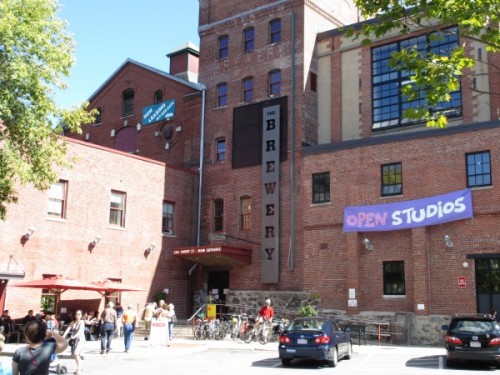
More jewelry, more crafts, more art. We spent an extra long time in the studio of Maggie Carberry, whose work hangs in our kitchen and in the dining room of my in-laws.

Lest you think this show is just for adults, let me add one last picture:

I would love people to put their own community pictures on my author page on Facebook. And if you feel like it, it would be great if you “liked” the page.
 On 08/22/2011, I wrote a post titled “PHOTO SHOT” where I described the process of shooting the cover for STILL AMONG THE LIVING (which will hopefully be available for downloading sometime toward the end of this month). What I didn’t write about was the process of choosing among a number of different possible covers and how the choice was made to go with the one I did.
 Although we rejected both of these, one thing I really liked was the angle of the picture primarily because it showed Mark Harris’s book THE SOUTHPAW. On the other hand there was general agreement that in these versions the colors didn’t “pop,” my name and “A Matt Jacob Novel” were too washed out. And no one really liked the lettering.
 This one’s lettering took too much of the picture of the table, plus the lettering itself didn’t cut it for any of us.
 I really liked the lettering on the second of these two—given my deco predilections but Sue and Michael felt the picture wasn’t what they were looking for since there was too much of the table itself showing, especially the brown pattern, which took the focus off the other elements of the picture and again, my name and “A Matt Jacob Novel” were too washed out—though I argued if we lettered them white on this one, I’d be good with it. Sue and Michael countered that once we cropped the picture the proportions of the whole cover would change.
 Here were two were serious contenders. No hour and out with these. In fact, both of them made it to the final pick. The fonts worked, the lines on the bottom this one worked, though again we were going to have to pop my name and “A Matt Jacob Novel,” something that Michael indicated would be no problem.
 I, however, had an issue with this one. The left side shading on the picture seemed cool, and I liked the two-tone idea much more than the lines on the cover directly above. Yet I felt the left side shading seemed too washed out. By this time, however, I was feeling uncomfortable about sending Michael back to the boards. He assured me that he was enjoying the project and would certainly be willing to give it another go.
 Which he did and created the cover we all agreed upon: